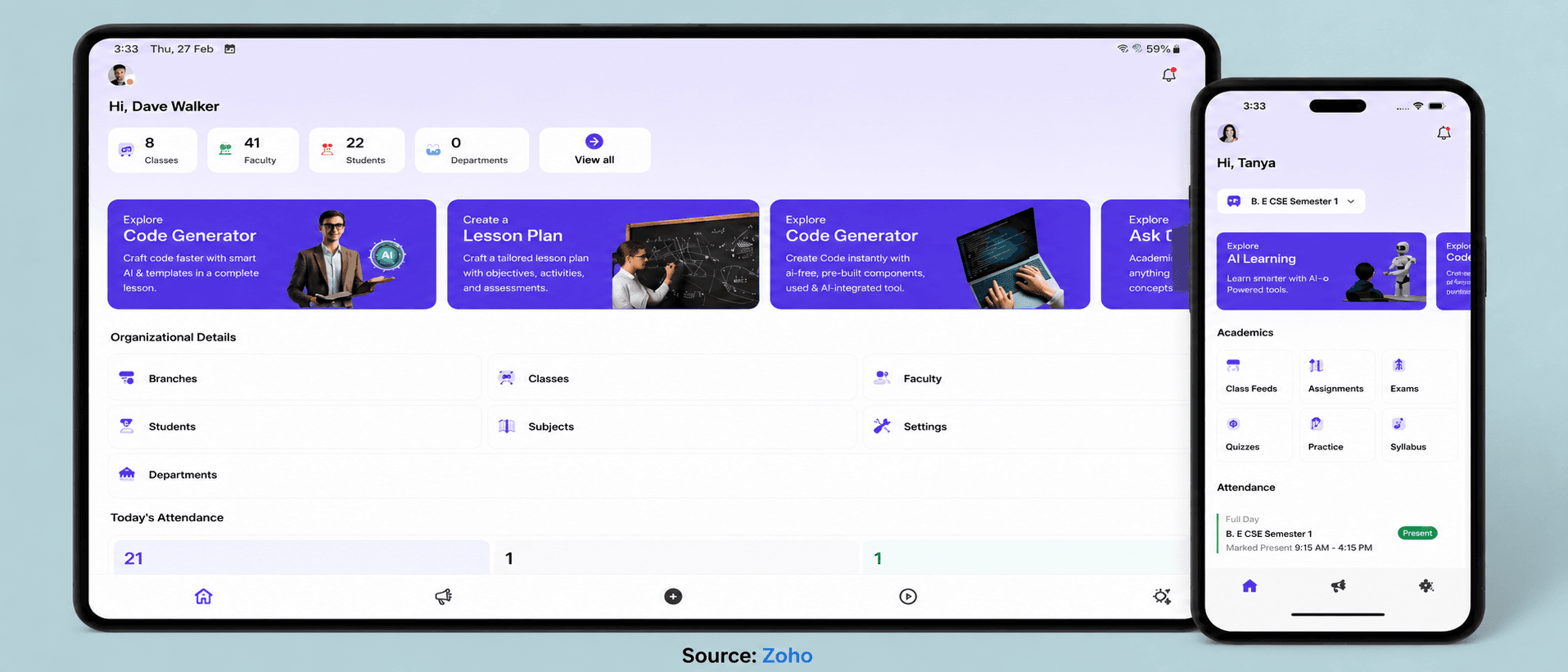
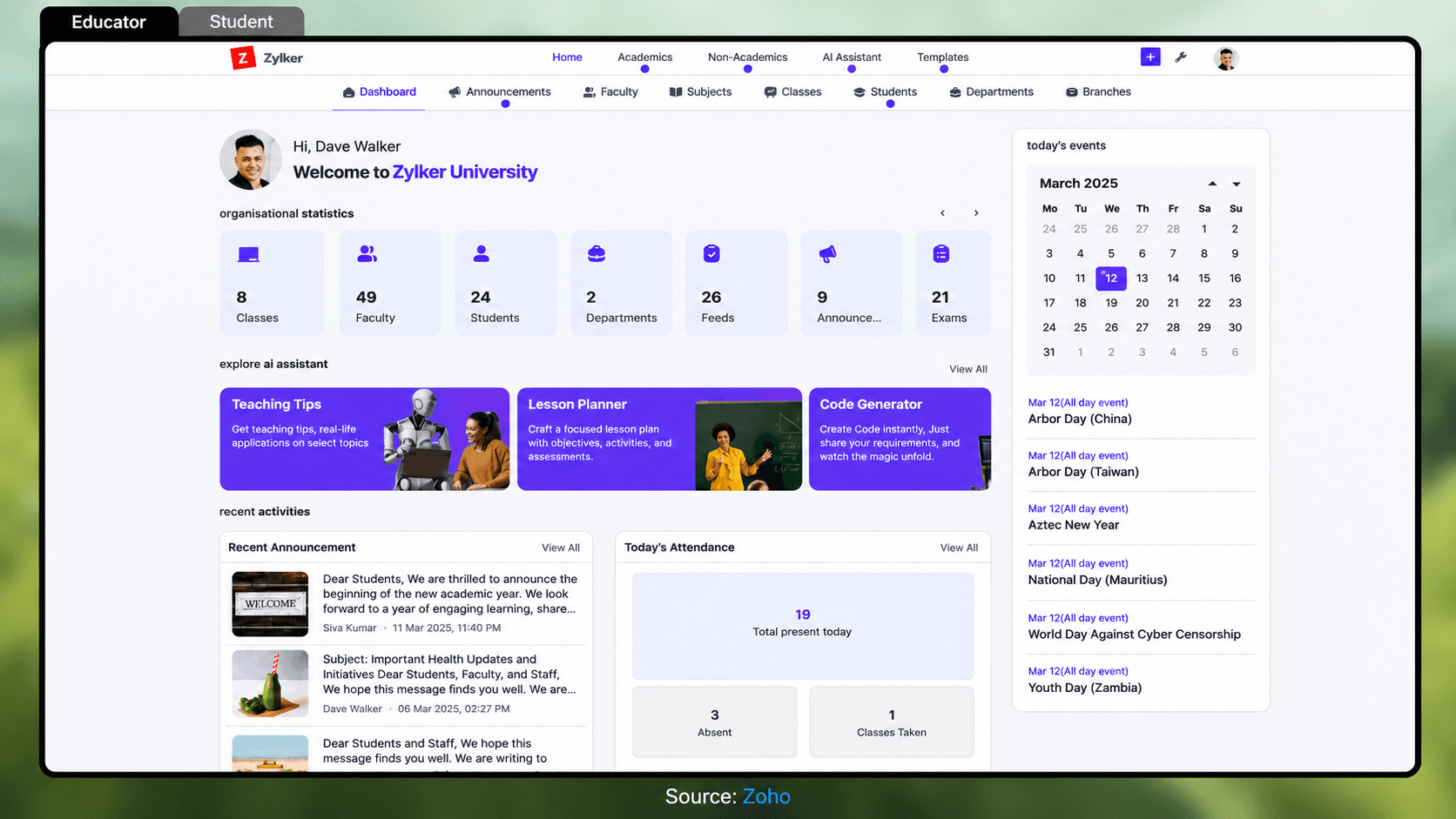
On July 15, 2026, Zoho launched Classes 2.0 — an AI-powered learning management system built in India, launching first in India, with global availability coming in the months ahead. It's a full academic platform covering teaching, learning, student management, and institutional administration.
The headline: every Central and State Government school, college, and university in India can use it at zero product licensing cost. Any individual teacher with up to 100 students can also use it free — regardless of institution type.
This isn't a stripped-down free tier. Zoho Classes 2.0 includes AI-driven lesson planning, automated grading, subject-specific AI tutors for students, an AI course builder that generates a structured course in under 30 seconds, and support for all 22 scheduled Indian languages.
Who Gets It Free — And What's the Catch?
The short answer: there is no catch for government institutions. Here's the breakdown:
Govt Schools & Universities
All Central & State institutions
Individual Teachers
Up to 100 students, any institution
Private Institutions
Per teacher/month in India
Outside India, the pricing structure has three tiers: free (up to 100 students per teacher), Standard at $7/instructor/month, and Pro at $20/instructor/month.
“Free” here means no product licensing fee. The platform runs on Zoho's own infrastructure — schools don't need to procure servers, pay hosting fees, or manage IT overhead. The product cost itself is removed from the equation for qualifying institutions.

What Makes It AI-Powered — The Key Features
This isn't AI bolted on as a marketing label. Zoho describes Classes 2.0 as an AI-native rebuild of their original COVID-era assignment tool, with intelligence woven into lesson creation, assessment, student engagement, and administration.
AI Course Builder — Full Course in 30 Seconds
Upload a syllabus, lesson plan, or topic. The AI generates video lesson outlines, reading materials, assignments with grading rubrics, adaptive practice tests — all mapped to Course Outcomes (CO) and Programme Outcomes (PO). Teachers can choose from over 100,000 curriculum templates as a starting point.
Subject-Restricted AI Tutor
Students get an AI tutor that only answers questions within their enrolled subjects. It won't function as a general-purpose chatbot — a deliberate design choice to prevent misuse and keep students on-curriculum. Institutions can enable or disable AI access entirely based on their own policies.
Automated Grading — Up to 90% Time Saved
MCQ and coding assignments are graded automatically. Zoho claims this can cut evaluation time by up to 90%, letting teachers redirect that time into actual teaching and student interaction.
AICTE Accreditation Support
Course outcome mapping is built in, helping colleges prepare the accreditation reports required by AICTE and other regulatory bodies — without manually compiling data across spreadsheets.
22 Indian Languages
Full support for all 22 scheduled languages — Hindi, Tamil, Telugu, Bengali, Marathi, Gujarati, Kannada, Malayalam, Odia, Punjabi, Urdu, Assamese, and more. This makes it accessible to institutions and students across every Indian state.
Built in India — Data Sovereignty and Compliance
Zoho Classes 2.0 is built entirely on Zoho's own technology stack — no third-party cloud dependencies for core functionality. Data residency is in India, and the platform is compliant with the Digital Personal Data Protection Act (DPDP).
For educational institutions handling student data — particularly minors — this matters. Schools don't need to evaluate complex data-processing agreements with foreign cloud providers. Student information stays within Indian data centres, governed by Indian law.
This aligns with Zoho's broader stance on technology sovereignty — the same philosophy that drove their recent Made-in-India ERP launch and Sridhar Vembu's public advocacy for India building its own tech stack independently of foreign providers.
Classes handles teaching. For running the institution itself (admissions, fees, attendance and staff records), Zoho launched Zoho Campus in September 2026, also hosted in India.
Who's Already Using Zoho Classes
Zoho Classes 2.0 didn't launch cold. The platform has been in use by institutions during its development phase, and Zoho cited the following usage metrics at launch:
Notifications delivered
Assignment submissions
Minutes of content
Teacher-created video
Named institutions already using the platform include SRM Institute, Sishya School, Chettinad Health City, CGIHM, Vidya Mandir, Grace International School, and GSE Institute, alongside government education bodies.
The product is the result of nearly five years of development and direct conversations with roughly 1,000 teachers — led by Dev Anand Ramasamy, VP of Product Management at Zoho.

How to Get Started
Zoho Classes 2.0 is live now. Here's how different types of users can get started:
Government institutions
Sign up at zoho.com/classes — the zero licensing cost applies automatically to verified Central and State government schools, colleges, and universities.
Individual teachers
The free-for-teacher license covers up to 100 students. Create an account, add classes, and invite students — no institutional approval required.
Private institutions
Subscription pricing starts at ₹500/teacher/month in India. Sign up through the same portal and select the appropriate plan.
Need Help Getting Your School Set Up?
Even when the platform is free, rolling it out across an institution takes planning — account setup, course migration, training teachers, configuring policies. As a Zoho implementation partner, we help schools and colleges get up and running smoothly.
Talk to Us About Setuparrow_forwardFrequently Asked Questions
Is Zoho Classes 2.0 really free for government schools?expand_more
Yes. Zoho is making Classes 2.0 available at zero product licensing cost to all Central and State Government schools, colleges, and universities in India. There is no trial period mentioned — the free tier applies to government institutions without a licensing fee. Additionally, any individual teacher with up to 100 students can use the platform free of charge, regardless of whether they are at a government or private institution.
What languages does it support?expand_more
Zoho Classes 2.0 supports all 22 scheduled Indian languages, including Hindi, Tamil, Telugu, Bengali, Marathi, Gujarati, Kannada, Malayalam, Odia, Punjabi, Urdu, Assamese, and others. This makes it one of the most linguistically comprehensive education platforms available in India.
How does the AI tutor work?expand_more
The AI tutor in Zoho Classes 2.0 is subject-restricted — it only responds to questions within the student's enrolled subjects and will not function as a general-purpose chatbot. This design prevents misuse and keeps students focused on their curriculum. Institutions also have the option to enable or disable AI access based on their own policies.
Does it work for private schools and coaching centres?expand_more
Yes, but private institutions are charged on a subscription basis. In India, pricing starts at ₹500 per teacher per month. Outside India, Zoho offers three tiers: free (up to 100 students per teacher), Standard at $7/instructor/month, and Pro at $20/instructor/month. The free-for-government-schools offer applies exclusively to Central and State government educational institutions in India.
Is student data stored in India?expand_more
Yes. Zoho Classes 2.0 is built on Zoho's own technology stack with data residency in India. The platform is compliant with India's Digital Personal Data Protection Act (DPDP). Zoho does not depend on third-party cloud providers for its core infrastructure, which means student and institutional data remains within Indian data centres.
This article reflects information verified as of July 18, 2026, from reporting by the Economic Times, India Today, Financial Express, The Hindu Business Line, Indian Express, Convergence Now, CIO&Leader, CXOToday, Chennaionline, APAC News Network, and Zoho's official product pages.
Zoho Classes 2.0 is a newly launched platform. We will update this article as adoption data, state government confirmations, and user feedback become available.