Shopify Migration Services
Move to Shopify without losing the search rankings you spent years earning.
- check_circle
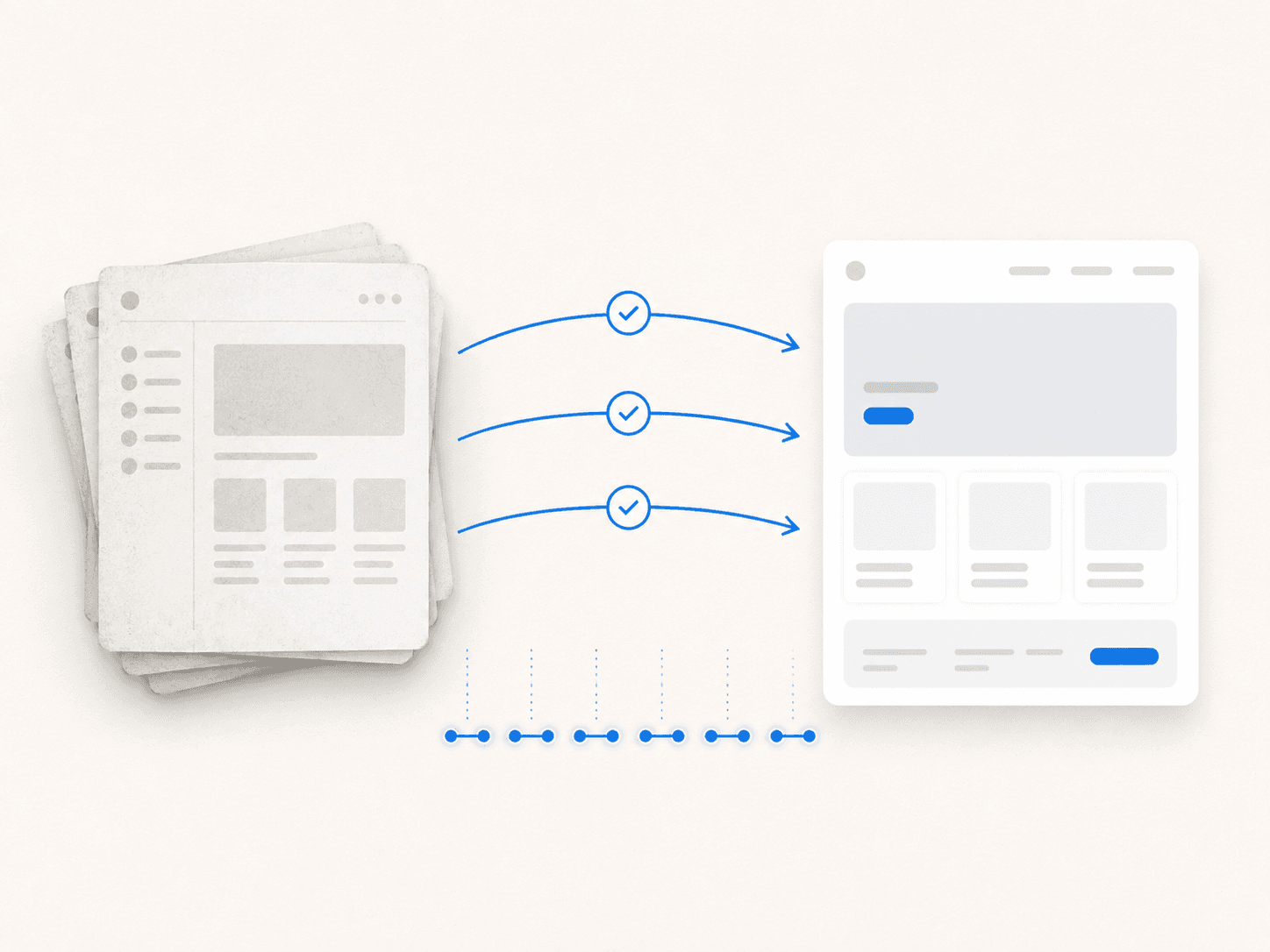
Products, variants, collections, customers, and order history carried across
- check_circle
Old URLs mapped to new ones with 301 redirects, so SEO survives launch day
- check_circle
Staged cutover with a rollback plan, not a single irreversible switch
301 Redirects
Mapped Before Launch
Full History
Orders and Customers Preserved
Staged
Cutover With Rollback Plan
India, GCC & Africa
Remote-First Delivery
Most botched migrations lose traffic, not data
Moving the products across is the part everyone plans for. The damage usually happens elsewhere — old product URLs that quietly start returning 404s, review content left behind on the previous platform, and a launch performed as a single overnight switch with no way back. Traffic falls, and the cause is not obvious for weeks.
Old URLs left to 404
Every ranking product page on the old platform had a URL. If those are not redirected, the rankings and any backlinks pointing at them are lost.
Order history abandoned
Teams frequently migrate products but not customers or past orders, so support loses the ability to answer questions about anything bought before the move.
A single overnight cutover
Switching in one irreversible step means any problem discovered at 2am is a problem you live with until it is fixed under pressure.
Messy source data carried over
Years of duplicate products, inconsistent variants, and abandoned collections get copied verbatim rather than cleaned on the way through.
What a migration actually involves
A migration is a data project and an SEO project at the same time. Both halves have to be planned before anything moves.
Full data migration
Products, variants, images, collections, customers, and order history moved across with their relationships intact rather than flattened.
URL mapping and redirects
Every indexed URL on the old platform mapped to its Shopify equivalent, with 301 redirects in place before the switch rather than after.
Data cleanup in transit
Duplicates merged, variant structures normalised, and dead collections dropped — so you launch with a tidier catalogue than you had.
Theme rebuild on Shopify
Your storefront rebuilt as an Online Store 2.0 theme rather than a pixel-copy of the old site forced awkwardly onto a new platform.
Payments and shipping reconfigured
Gateways, tax rules, and shipping zones set up and tested with real transactions before you take a live order.
Integrations reconnected
Accounting, ERP, and marketing tools rewired to the new store, so nothing silently stops syncing on launch day.
What changes after the move
Before
- close
Product URLs return 404 and rankings quietly disappear
- close
Order history stranded on a platform you are still paying for
- close
Every plugin update risks breaking checkout
- close
Hosting, security patches, and uptime are your problem
- close
Nobody is certain which of the 40 installed plugins matter
After
- check_circle
Old URLs redirect to their new equivalents, rankings carried across
- check_circle
Full customer and order history searchable inside Shopify
- check_circle
Checkout maintained by Shopify, not by a plugin chain
- check_circle
Hosting, PCI compliance, and uptime handled by the platform
- check_circle
A documented store your team can actually reason about
How we run a migration
Audit and URL inventory
We export every indexed URL on the current store and map it to its Shopify destination before touching data. This mapping is the migration plan.
Trial migration
A full data run into a development store, so you can see exactly what carries across and what needs cleaning — well before any live cutover.
Build and reconnect
Theme built on Shopify, payments and shipping configured, and integrations rewired, all validated against the trial data.
Staged cutover
Final data sync, redirects activated, DNS switched, then monitoring of crawl errors and rankings for the weeks that follow — with a rollback path throughout.
Shopify migration questions
Will we lose our Google rankings when we migrate to Shopify?expand_more
Not if the migration is planned properly. Rankings are attached to URLs, so the critical work is mapping every indexed URL on your existing store to its Shopify equivalent and putting 301 redirects in place before the switch. We treat that mapping as the migration plan rather than a task at the end. Expect some fluctuation for a few weeks while Google reprocesses the site — that is normal and recovers.
Can you migrate our past orders and customer accounts?expand_more
Yes. Products, variants, collections, customers, and order history all move across. Customer passwords cannot be migrated from most platforms for security reasons, so customers are prompted to reset on first login — we set up that flow as part of the launch.
Which platforms do you migrate from?expand_more
WooCommerce, Magento, OpenCart, Wix, BigCommerce, and custom-built stores. The platform matters less than the state of the data — a tidy Magento store is a far easier migration than a WooCommerce store with eight years of accumulated plugins and duplicate products.
How long does a Shopify migration take?expand_more
Typically four to eight weeks, depending mostly on catalogue size and how clean the source data is. The trial migration usually reveals the real timeline — a store with a well-structured catalogue moves quickly, while one needing significant cleanup takes longer.
Will our store go offline during the migration?expand_more
No. The new store is built and tested in parallel while your existing store keeps trading. The cutover itself is a DNS switch, which is close to instant, and we keep a rollback path available in case anything unexpected appears.
Can you clean up our product data during the migration?expand_more
Yes, and we usually recommend it. A migration is the one moment when touching every product is already necessary, so merging duplicates, normalising variant structures, and dropping dead collections costs little extra and leaves you with a tidier catalogue than you started with.
Migration is one part of what we do
Most replatforming projects also involve a theme rebuild and performance work. See the full picture, or read about the pieces next to this one.
Also see: Shopify theme development · Shopify speed optimisation