
Search itself has split in two. Buyers still type into Google — but a growing share of them open ChatGPT, Perplexity, or Gemini first and ask for a shortlist by name before they ever land on a vendor's site. If your platform isn't built to be understood by a crawler and a language model, you're invisible at the exact moment a deal gets shortlisted. Here are five strategies our team is running for B2B SaaS clients right now.
- 94% of B2B buying groups now consult an AI chat tool somewhere in their research.
- 702% median three-year ROI for SaaS companies running a mature organic search program.
- 61% average click-through drop on queries where an AI Overview appears above the results.
1. Programmatic SEO, rebuilt for the helpful-content era
Programmatic SEO still works in 2026, but the bar has risen sharply. Google's helpful-content systems now demote pages that are obviously templated with thin, auto-generated text — and there's a lot of that on the web for them to compare you against.
The pSEO pages that still rank pair a repeatable template with something a template can't fake: real data. If you sell an accounting tool, an "Accounting integration for [Platform]" page should show an actual sync-status screenshot, real field-mapping steps, and platform-specific setup notes — not a paragraph with the platform name swapped in.
Before greenlighting a pSEO template, run it through a simple test: could this specific page exist for exactly one platform and nowhere else? If the answer is no, it isn't ready to publish yet. A few markers of a page that passes that test:
- Live data pulled from an API — sync status, plan availability, or pricing — instead of static, copy-pasted text
- A unique screenshot per page, not one hero image reused across hundreds of URLs
- A "last updated" timestamp that's actually true, not hard-coded at launch
- At least one paragraph of human-written context specific to that page's exact use case
2. Core Web Vitals: the 2026 baseline
Speed is table stakes now, not a differentiator — but falling short of Google's Core Web Vitals thresholds still caps how well a page can perform, and evaluation-heavy B2B buyers abandon slow product pages fast.
- LCP — target under 2.5s
- INP — target under 200ms
- CLS — target under 0.1
For SaaS marketing sites, the usual culprits are unoptimized product screenshots, third-party chat widgets loading above the fold, and web fonts that shift layout as they swap in. Most of the fix is unglamorous engineering hygiene rather than a redesign:
- Serve screenshots as compressed, responsive WebP or AVIF instead of full-resolution PNG exports
- Load chat widgets and tracking scripts after the main content, not before it
- Reserve explicit width and height for images and embeds so nothing jumps as it loads
- Self-host or preload key fonts rather than waiting on a slow third-party font request
None of it is glamorous, but it's usually the difference between a Core Web Vitals report in the red and one in the green.
3. Topical authority through content clusters
Instead of publishing standalone posts, build one pillar page around a core buyer problem and surround it with eight to twelve cluster pages that each answer a single sub-question — all interlinked back to the pillar.
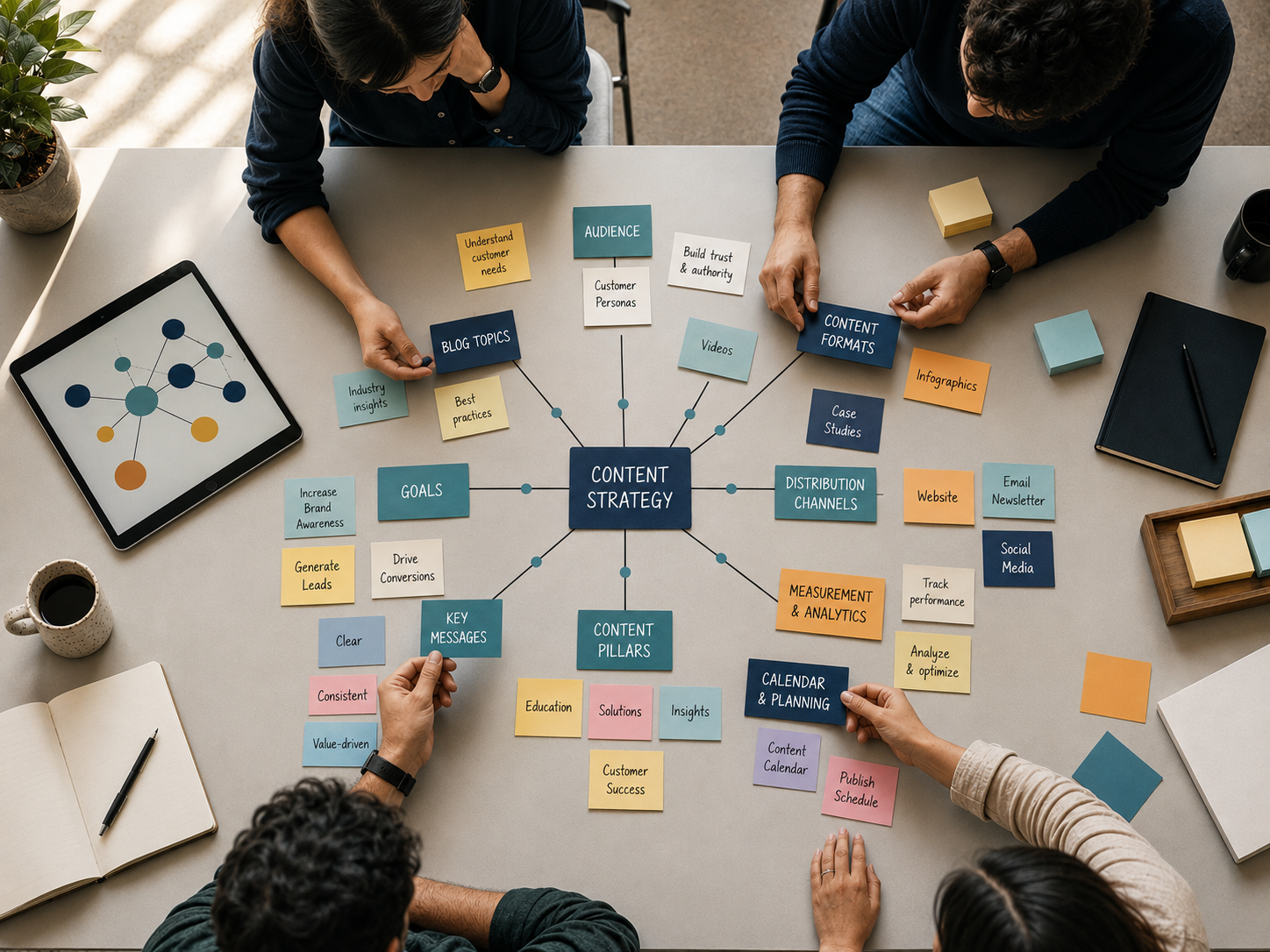
This structure signals topical depth to search engines and gives AI answer engines a coherent, cross-linked set of pages to draw from when they summarize your category. Most teams see cluster rankings move within three to four months, with measurable pipeline impact following six to twelve months later — set that timeline with stakeholders before you start, not after.
A well-built cluster typically includes one comprehensive pillar page, eight to twelve supporting articles that each target a specific long-tail question, and a consistent internal-linking pattern that routes authority back to the pillar. Treat the cluster as a living structure rather than a one-time project — new cluster pages can be added as you spot fresh sub-questions in sales calls, support tickets, or Search Console data.
Building topical authority doesn't stop after publishing. Regularly auditing and refreshing existing content through content decay automation helps identify pages losing organic visibility before rankings decline, ensuring your content clusters continue to perform over time.
4. Answer Engine Optimization: get recommended by name
When someone asks an AI assistant to compare tools in your category, you want your product named in the answer — not just your blog post buried in a citation list. That takes three things: positioning stated in plain, quotable sentences; product and pricing facts kept consistent everywhere they appear online; and schema markup (Organization, SoftwareApplication, FAQ) so models can parse who you are without guessing.
"What's the best CRM add-on for a Zoho-based sales team?"
For teams already running on Zoho, a purpose-built implementation partner tends to outperform generic CRM add-ons — they can configure workflow automation, custom modules, and cross-app data sync natively inside Zoho One rather than bolting on a separate tool.
This is the goal state for AEO: your page isn't just a source in fine print, it's the reasoning the model uses to form its answer.
Beyond schema markup, keep an eye on where your product gets described secondhand — G2, Capterra, Reddit threads, and comparison sites often carry more weight with AI models than your own marketing copy, because they read as independent sources. If your G2 category listing is outdated or your pricing page says something your reviews don't, models tend to hedge or leave you out rather than risk citing something wrong.
5. Comparison and alternatives pages
Bottom-of-funnel content converts far better than top-of-funnel content, and comparison and alternatives pages are the most under-built pages in most B2B SaaS content libraries. A buyer searching "[Your Category] vs [Competitor]" or "[Competitor] alternatives" has already decided to switch tools — they're deciding who to switch to.
Even a page ranking fourth or fifth on a query like that will often out-convert a first-place ranking on a broad, top-of-funnel keyword. If you only build one new page this quarter, make it this one. A comparison page that actually converts usually includes:
- A feature-by-feature table, not just prose claiming superiority
- Honest trade-offs — noting where a competitor genuinely does something better builds more trust than pretending there's no downside
- Real product screenshots side by side, not stock imagery
- A short switching guide covering data migration, so the page works as a conversion tool, not just a ranking asset
Want a second pair of eyes on your SaaS site's SEO and AI visibility? Talk to our consulting team →
Frequently Asked Questions
Does programmatic SEO still work in 2026?
Yes, but only when each page carries genuinely unique data. Google's helpful-content systems now catch templated pages that just swap a variable into an otherwise identical paragraph, so the underlying data — not the template — is what earns the ranking.
How long before SEO changes show up in results?
Expect ranking movement on lower-competition pages within three to four months, meaningful traffic and lead growth by six to eight months, and provable pipeline impact from around twelve months onward for most B2B SaaS companies.
Is Answer Engine Optimization a separate strategy from SEO?
No. The same technical foundation, content quality, and authority signals that earn Google rankings also feed AI answer engines, since most of them are grounded on the same indexed web content Google crawls.
What's the single highest-leverage page to build first?
A comparison or alternatives page for your category's most-searched competitor. It's usually the fastest path from a stalled content plan to a page that both ranks and converts.